Nodes and networks
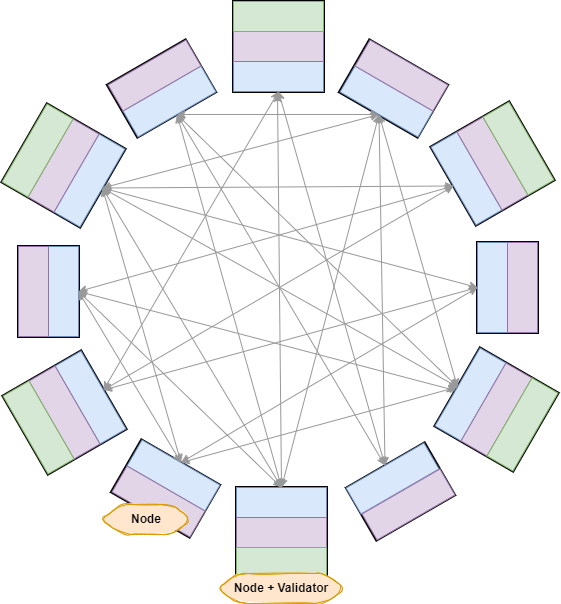
Ethereum is a decentralized network of nodes that communicate via peer-to-peer connections. These connections are formed by computers running Ethereum's specialized client software:
Nodes
An Ethereum node is a running instance of Ethereum's client software. This software is responsible for running the Ethereum blockchain.
There are two primary types of nodes in Ethereum: execution nodes and beacon nodes. Colloquially, a "node" refers to an execution node and beacon node working together. Nodes establish connections with other nodes running on other computers, forming a decentralized peer-to-peer network that processes Ethereum blocks and transactions.
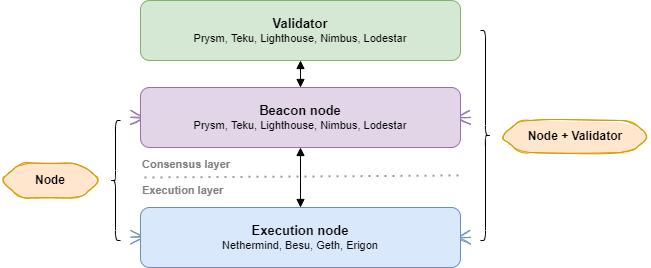
Users that operate validators use a separate validator client, which connects to a beacon node. It manages validator keys and duties such as proposing blocks and attesting to others' blocks. Validator clients connect to the Ethereum network through beacon nodes, which depend on execution nodes:
| Component | Description |
|---|---|
| Ethereum node aka "Node" | An Ethereum node is an execution node and beacon node working together. Ethereum nodes communicate peer-to-peer to secure the Ethereum network, and require both execution-layer client software and consensus-layer client software. |
| Execution node | Execution nodes use execution client software to process transactions and smart contracts in Ethereum's execution layer. Nethermind, Besu, and Go Ethereum (Geth) are examples of execution client software. An execution node will talk to other execution nodes via peer-to-peer networking, and to a local beacon node. |
| Beacon node | Beacon nodes use beacon node client software to coordinate Ethereum's proof-of-stake consensus. Prysm, Teku, Lighthouse, and Nimbus are consensus clients that contain both beacon node and validator client software. A beacon node will talk to other beacon nodes via peer-to-peer networking, to a local execution node, and (optionally) to a local validator. |
| Validator | Validator clients are specialized software that manage one or more validators in Ethereum's consensus layer. Validators propose blocks and attest to blocks proposed by others. A validator client requests duties from a beacon node and submits signed results through it. |
Networks
The Ethereum network that hosts real-world applications is referred to as Ethereum Mainnet. Ethereum Mainnet is the live, production instance of Ethereum that mints and manages real Ethereum (ETH) and holds real monetary value.
There are other live, test instances of Ethereum that mint and manage test Ethereum. Each test network is compatible with (and only with) its own type of test ETH. These test networks let developers, node runners, and validators test new functionality before using real ETH on Mainnet.
Every Ethereum network is divided into two layers: Execution Layer (EL) and Consensus Layer (CL):
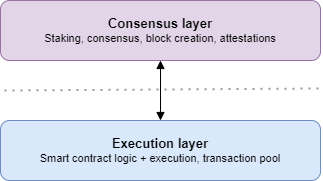
Every Ethereum node contains software for both layers: execution-layer client software (like Nethermind, Besu, Geth, and Erigon), and consensus-layer client software (like Prysm, Teku, Lighthouse, Nimbus, and Lodestar).
Every network's execution layer works with (and only with) its corresponding "partner" consensus layer. EL-CL network pairs work together to run Ethereum proof-of-stake.
| network | Description |
|---|---|
| Mainnet | When people refer to Ethereum, they're usually referring to Ethereum Mainnet, which refers to a pair of networks: execution-layer (EL) Mainnet and consensus-layer (CL) Mainnet. CL Mainnet is commonly referred to as the Beacon Chain. This network pair mints and manages real ETH. |
| Sepolia | Sepolia is a network that was created to smart contract testing. The Prysm Quickstart shows you how to configure a node on Sepolia. Note that this is a permissioned network, so you can run a node on Sepolia, but not a validator. This network pair mints and manages Sepolia ETH, a type of testnet ETH used exclusively within this network pair. |
| Hoodi | Hoodi the second long-standing, merged-from-genesis, public Ethereum testnet. Hoodi will replace Holešky as a staking, infrastructure and protocol-developer testnet in 2025. For testing decentralized applications, smart contracts, and other EVM functionality, please use Sepolia! See github.com/eth-clients/hoodi for more information. |
Frequently asked questions
Can I run an execution node without running a beacon node?
No. All Ethereum network participants need to run both an execution node and a beacon node.
What happened to miners?
Mining is a proof-of-work consensus mechanism. Ethereum's consensus is now driven by a proof-of-stake mechanism, which replaces miners with validators.
Where do slashers come into play?
Slashers detect slashable validator messages and submit evidence to the network. They are optional and are not required to operate a validator. Learn more in the slasher documentation.
How do I get testnet ETH?
You can request testnet ETH from public faucets. For Sepolia, try the Sepolia PoW Faucet or Alchemy's Sepolia Faucet. For Hoodi, check the Hoodi GitHub repository for available faucets. You can also ask the community for testnet ETH on either the Prysm Discord server or on r/ethstaker.